If you are considering replacing a missing tooth, you will naturally want to know how long dental implant treatment takes and when your final tooth will be fitted. Treatment usually takes place over several months, as it involves different stages: assessment, implant placement, healing and preparation of the restoration.
As a guide, the implant may need between two and six months to integrate with the bone. This is one part of the process; the overall timeline will also depend on whether you need an extraction, bone grafting or other preliminary treatment.
How long dental implant treatment takes at each stage
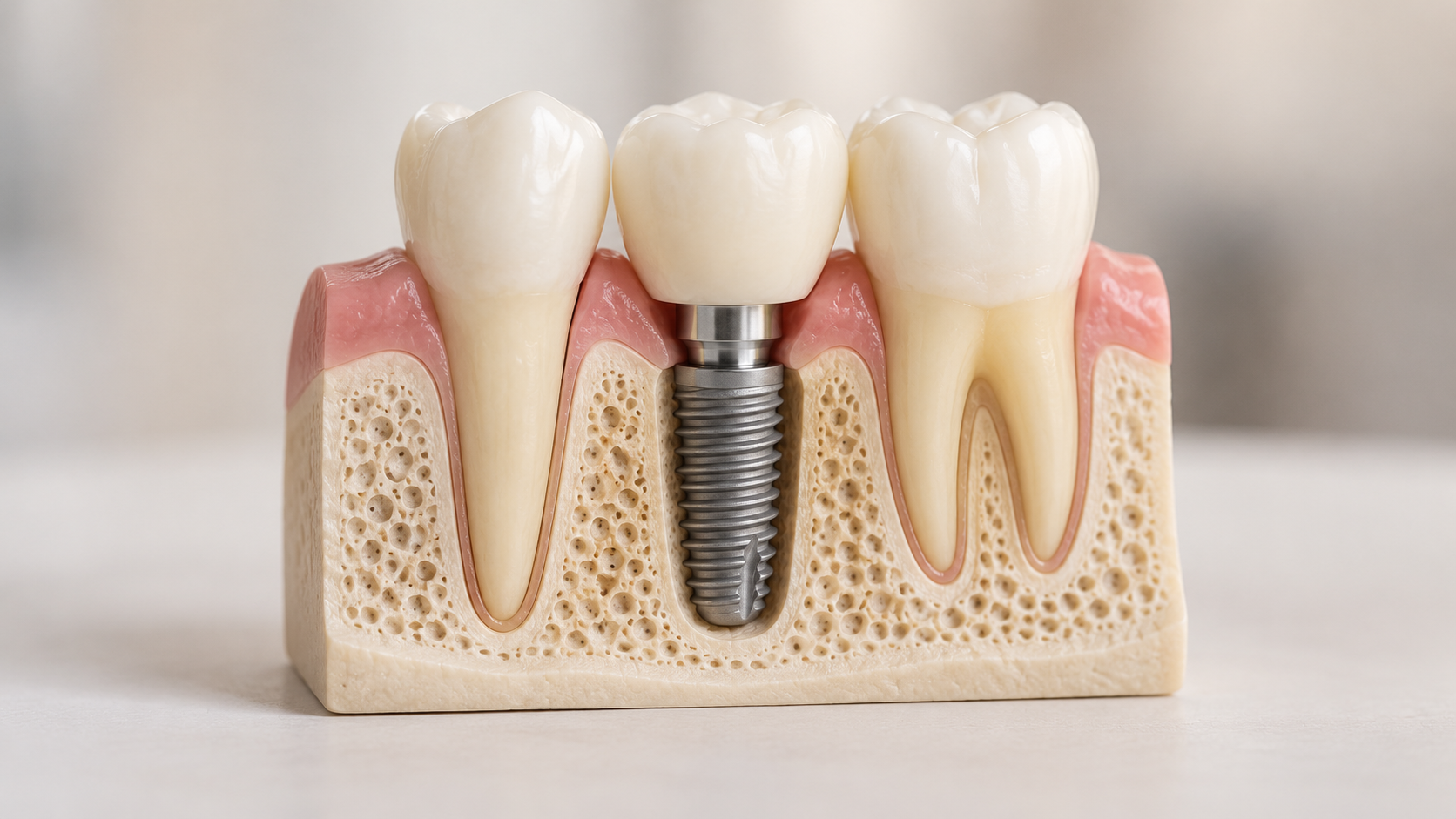
To understand the timeline, it helps to distinguish the implant — the component placed in the bone to replace the tooth root — from the crown, which forms the visible part of the replacement tooth.
Assessment and planning
The first step is to assess your mouth, gums and available bone. A clinical examination and any necessary imaging help establish where the implant can be placed and whether the area needs preparation beforehand.
Your medical and dental history will also be reviewed. This information allows the clinician to explain your options and outline an estimated treatment schedule.
Implant placement
An implant can be placed during a single appointment, but the length of the procedure depends on the number of implants, their location and the complexity of the treatment.
If the tooth still needs to be removed, it may be possible to place the implant during the same appointment. In other cases, the area is left to heal first. This decision depends on the clinical conditions, so the same schedule will not be suitable for everyone.
Healing and integration with the bone
Once the implant has been placed, osseointegration begins: the process through which the implant bonds with the surrounding bone.
The gum may heal before this stage is complete. Feeling comfortable or no longer experiencing discomfort does not necessarily mean the implant is ready to support the final restoration. Review appointments allow the clinician to monitor healing and decide when to proceed.
Preparing and fitting the restoration
When the tissues are ready, the necessary records and checks are carried out to prepare the crown or other restoration. Its fit, shape, appearance and contact with the opposing teeth are assessed.
This stage may also require several appointments. The schedule depends on the type of restoration and any adjustments needed.
Can an implant and a replacement tooth be fitted on the same day?
In selected cases, a temporary restoration can be fitted on the day of surgery or shortly afterwards. The implant’s initial stability and the condition of the treatment site are among the factors considered.
Having a temporary tooth fitted does not mean that integration with the bone is complete. You will still need to follow the instructions provided about eating, using the restoration and attending review appointments.
Placing an implant immediately after an extraction and fitting a restoration onto it are also separate decisions. Both need to be planned around your individual circumstances.
What can extend the treatment timeline?
One important factor is the amount of available bone. If a bone graft or bone regeneration is required, an additional healing period may be needed. Some procedures can be carried out alongside implant placement, while others require a separate preliminary stage.
Other factors include the need to address oral health problems before surgery, the complexity of the restoration and how your tissues heal. The schedule therefore needs to be reviewed as treatment progresses.
Before starting, it is useful to ask which stages are planned, what could affect the timing and when the decision will be made to fit the final restoration.
Will I have a gap while the implant heals?
The options during healing depend on your circumstances. Different temporary solutions may be considered, taking into account the location of the gap, appearance and the need to protect the treated area.
Discuss this during the planning stage: which temporary option may be suitable, whether it will be fixed or removable, and how you will need to care for it. The European Federation of Periodontology provides patient information about the stages and components of dental implant treatment.
Same-day treatments and CEREC technology
CEREC technology allows certain restorations, such as crowns, to be designed and manufactured in a single visit when clinically appropriate. It can help streamline the production of the restoration, while the implant’s healing and integration time must be assessed separately.
When asking about a same-day treatment, it is important to understand which procedure is being described and whether the replacement tooth will be temporary or final.
A treatment schedule tailored to you at La Campana
An assessment is the first step towards understanding how long dental implant treatment may take in your case. At Clínica Dental La Campana, in Nueva Andalucía, we can assess your needs and explain the planned stages of your dental implant treatment in Marbella.
If you need to arrange treatment around work, travel or a stay in the area, mention this from the outset so that a realistic schedule can be discussed. Request an appointment to have your questions answered before you begin.